
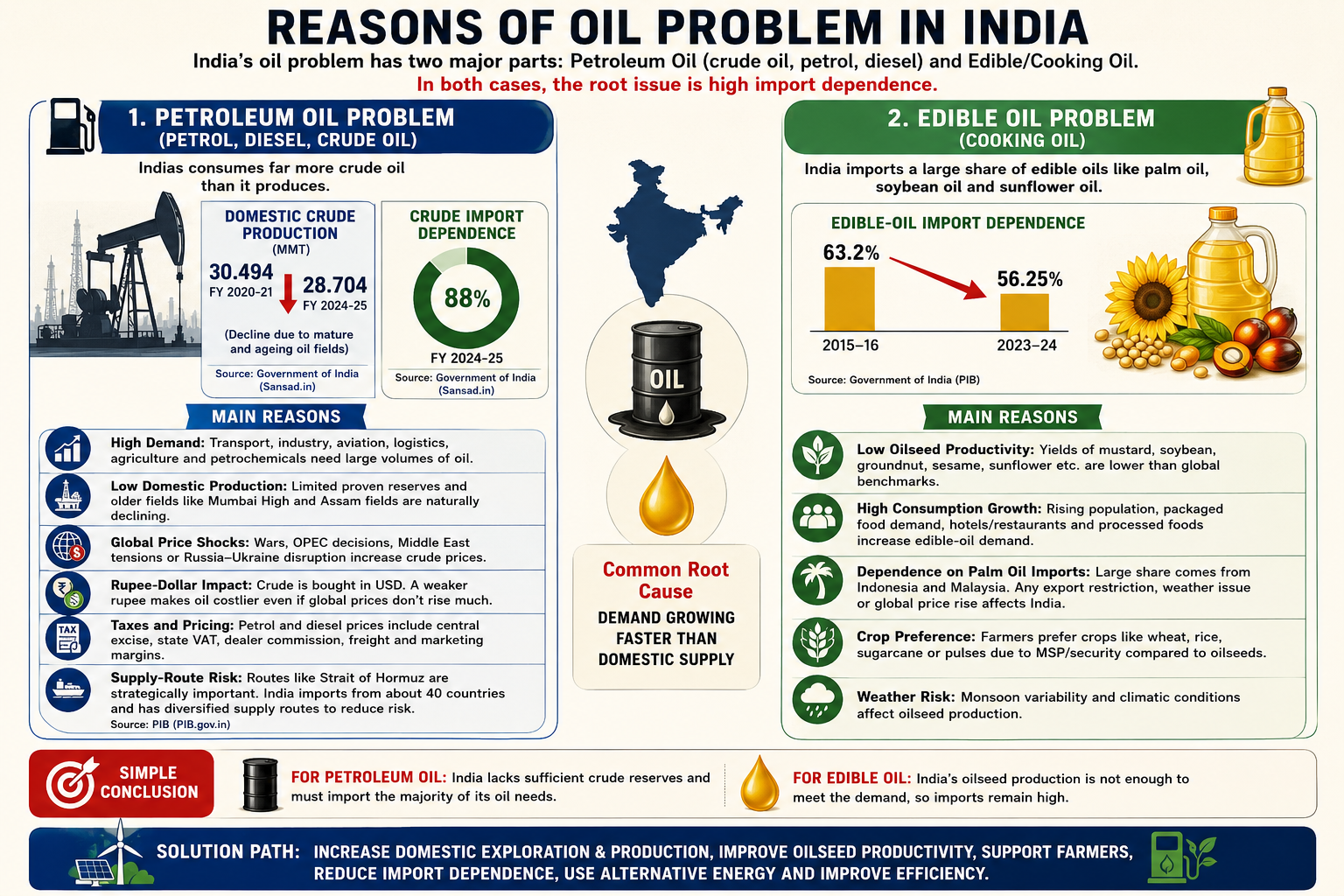
India’s “oil problem” has **two major meanings**: **petroleum oil** and **edible/cooking oil**. In both cases, the root issue is **high import dependence**.
## 1. Petroleum oil problem: petrol, diesel, crude oil
India consumes far more crude oil than it produces. Domestic crude production has been declining; government data cited in Parliament shows production fell from **30.494 MMT in FY 2020–21 to 28.704 MMT in FY 2024–25**, mainly due to mature and ageing oil fields. India’s crude import dependence was around **88% in FY 2024–25**. ([Digital Sansad][1])
Main reasons:
**High demand:** Transport, industry, aviation, logistics, agriculture, and petrochemicals need large volumes of oil.
**Low domestic production:** India has limited proven crude reserves, and older fields such as Mumbai High and Assam fields are naturally declining. ([Digital Sansad][1])
**Global price shocks:** When crude prices rise due to war, OPEC decisions, Middle East tension, or Russia–Ukraine disruption, India’s import bill rises quickly.
**Rupee-dollar impact:** Crude oil is mostly purchased in USD. If the rupee weakens, oil becomes costlier even if global crude prices do not rise much.
**Taxes and pricing:** Petrol and diesel prices include central excise, state VAT, dealer commission, freight, and marketing margins. So retail prices do not always fall in line with crude prices.
**Supply-route risk:** India imports crude from many countries, but routes such as the Strait of Hormuz remain strategically important. The government has said India now imports crude from around **40 countries** and has diversified supply routes to reduce risk. ([Press Information Bureau][2])
## 2. Edible oil problem: cooking oil
India also imports a large share of edible oils such as palm oil, soybean oil, and sunflower oil. Government material says India’s edible-oil import dependence declined from **63.2% in 2015–16 to 56.25% in 2023–24**, but consumption has risen, keeping pressure high. ([Press Information Bureau][3])
Main reasons:
**Low oilseed productivity:** India grows mustard, soybean, groundnut, sesame, sunflower, etc., but yields are lower than global benchmarks.
**High consumption growth:** Rising population, packaged food demand, hotels/restaurants, and processed foods increase edible-oil demand.
**Dependence on palm oil imports:** A large portion comes from Indonesia and Malaysia. Any export restriction, weather issue, or global price rise affects India.
**Crop preference:** Farmers often prefer wheat, rice, sugarcane, or pulses due to MSP/security compared with oilseeds.
**Weather risk:** Monsoon variability affects oilseed output.

Comments (0)
No comments yet. Be the first to share your thoughts!